How to choose a web design agency, without guessing

Choosing a web design agency comes down to four checkable things: whether they diagnosed your specific problem or just pitched, who writes the content, what you own at the end, and whether they can show a comparable project with what changed after launch. Everything else on an agency website is a claim. Ask every firm the same questions, write the answers down, and the decision usually makes itself.
Download the Comparison Sheet↓Word + PDF, no email required
What actually separates agencies
Not the portfolios. Past a basic level of competence, most agency portfolios look interchangeable, because a portfolio shows the launch day and none of the two years after it. The differences that decide whether you’re happy in that second year are less photogenic: who does the thinking, who does the writing, what you own, and what happens when you ask for a change in month nine.
A word on whether you need an agency at all, because the honest answer is not always. If you have a steady, genuinely full week of web work every week, an in-house hire can be the better answer, and in-house vs agency works through that decision. A freelancer suits a defined, single-skill project, with the trade-offs agency vs freelancer covers. This guide is for the case where you've decided on a firm and are choosing between them.
One data point for calibration: when we audited more than 55,000 US B2B websites, 68% never plainly said what the company does. Most of those sites were built by somebody. The lesson isn't that agencies are bad, it's that hiring one doesn't automatically buy clarity, so the selection questions below aim at the failures that actually happen.
The questions worth asking, and what a good answer sounds like
Ask every firm the same questions, in the same words, and write the answers down while they’re fresh. The pattern across answers tells you more than any single one.
| Ask | What a good answer sounds like |
|---|---|
| What do you think is wrong with our current site? | A good answer is specific and slightly uncomfortable: it names a page, quotes your own copy, or points at a number. Vague enthusiasm about your potential is the weakest possible answer, because it means nobody looked. |
| Who writes the content, and how? | A good answer names a process: they interview your team and write the pages, and your people review for accuracy. The answer that predicts a stalled project is a spreadsheet of empty fields with your name on the deadline. |
| What do we own when this is over? | The only good answer is everything: code, content, domain registration, analytics, and the hosting account, in your company's name. Ask what leaving looks like in a year. Hesitation here is the most expensive warning sign on this list. |
| Can you show a project for a business shaped like ours? | A good answer is one comparable project with what changed afterward: enquiries, quote requests, rankings. A gallery of nice screenshots for restaurants and startups is an answer too, just not to the question you asked. |
| How will you protect the rankings we already have? | A good answer names the mechanics without being prompted: a URL inventory, a one-to-one redirect map, a baseline before launch, monitoring after. A proposal that never mentions redirects is telling you who handles the aftermath: you. |
| What would you cut if the budget were 30% lower? | There is no wrong answer, only an informative one. What a firm protects under pressure is what it believes matters, and what it offers to cut first is what it was padding. |
How to compare proposals that aren’t comparable
Left to themselves, three agencies will send three documents scoped to three different imaginary projects, and the only number you can line up is the price, which is how price quietly becomes the decision. The fix is to give every firm the same brief. Our website RFP template exists for exactly this, and it works as an informal brief even when nothing about your process is formal.
When the proposals arrive, score them against written criteria rather than reading them like brochures. If more than two people are involved in the decision, the RFP scoring matrix keeps the comparison honest with weighted criteria, so the best deck doesn't beat the best plan.
When two quotes are far apart, resist the conclusion that one firm is greedy. The usual explanation is that the cheaper one excludes something: the content nobody has agreed to write, the redirects, the support after launch. Ask each firm what is explicitly not included, and watch the numbers converge.
The SEO migration question most buyers forget
If your current site ranks for anything, a redesign can silently destroy it: rankings belong to URLs, and a project that changes URLs without a one-to-one redirect map forfeits what those pages earned. Ask every candidate, unprompted, how they'll protect existing rankings through the move. The good ones answer in a paragraph, naming the URL inventory, the redirect map, the pre-launch baseline, and the monitoring window. Our website migration checklist shows what that plan looks like, whoever you hire.
The agency comparison sheet
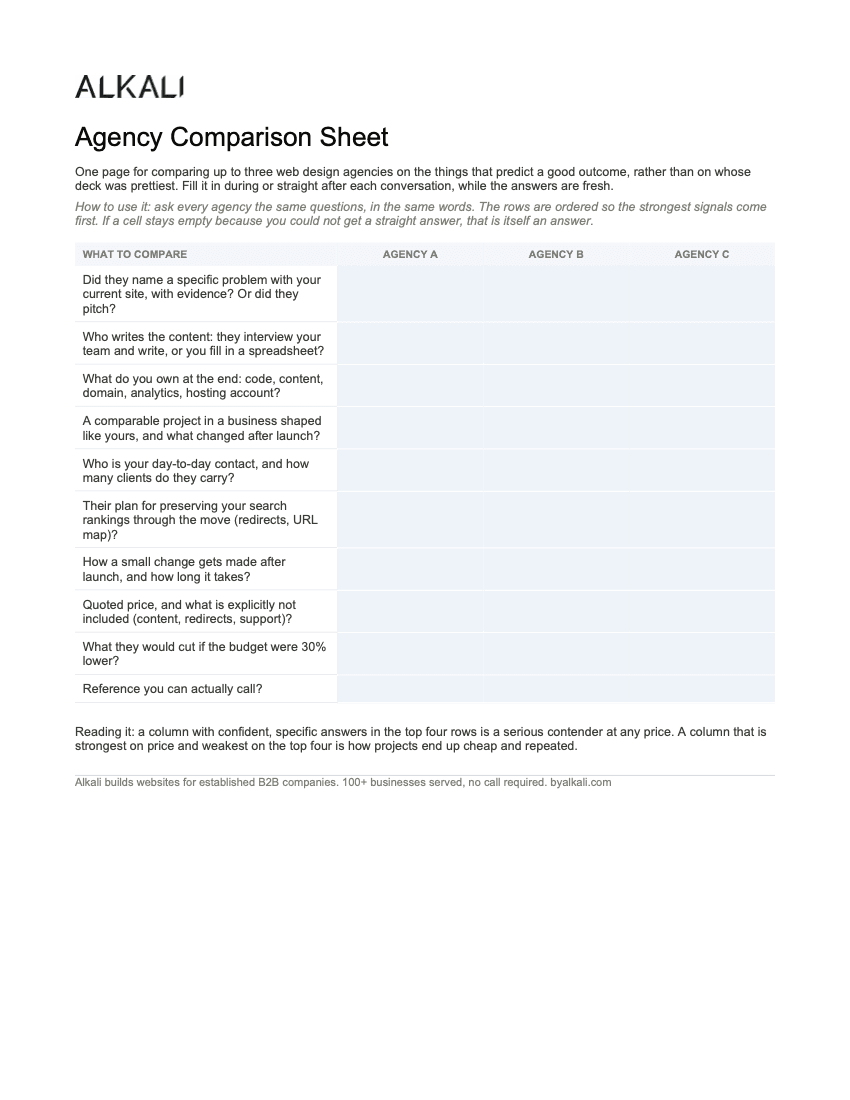
One page, three columns, the ten questions from this guide in scoring order. Fill it in during or straight after each conversation. An empty cell where a straight answer should’ve been is itself an answer.
Red flags
A proposal without a diagnosis.If nobody named what’s costing you buyers before quoting a price, you received a price for work, not a plan for an outcome.
The agency keeps something of yours. The domain, the hosting account, the only admin login. This is the arrangement that costs the most to unwind later, and it's common enough that we keep a public list of the warning signs clients wish they'd caught earlier.
No mention of redirects on a redesign. Covered above, and repeated because it’s the expensive one: the silence is the signal.
“Tell us exactly what you want.” Early in scoping this is a fair question. As the standing mode of the relationship, it means you’ve hired hands and kept the thinking, which is the opposite of what an agency is for.
What to agree before signing
Five things in writing, none of them exotic: who owns the code, content, domain, and accounts at the end; who writes the content and to what deadline; the redirect plan, if any URLs change; how post-launch changes get requested, and the expected turnaround for a small one; and what happens to your site and files if either side walks away. Every good agency has answered all five a hundred times. The value of asking is finding out, cheaply and early, if you’re talking to one that hasn’t.
If your project is specifically B2B, what a B2B web design agency does differently covers the version of this evaluation where the buyer is a committee and the site's job is surviving a side-by-side comparison.
Common questions
How do I choose a web design agency?
Shortlist two or three firms, ask each the same questions, and compare the answers in writing. The four that separate agencies fastest: did they diagnose a specific problem with your current site, who writes the content, what do you own at the end, and can they show a comparable project with results. Score the answers rather than the decks, and the decision usually makes itself.
What questions should I ask a web design agency?
Ask what they think is wrong with your current site, who writes the content and how, what you own when the project ends, whether they can show a comparable project with what changed after launch, how they will protect your existing search rankings, and what they would cut if the budget dropped 30%. The pattern in the answers matters more than any single one.
How much should a web design agency cost?
It varies with scope more than with the agency. Page count matters less than people expect; custom functionality and who writes the content matter most. When two quotes look far apart, the gap is usually something excluded from the cheaper one, most often content, redirects, or post-launch support. Ask each firm what is not included and the numbers tend to converge. For calibration, our own projects start at $15,000.
Should I hire a freelancer instead of an agency?
Sometimes, honestly. A freelancer suits a defined project with a clear scope and a single skill at its centre. An agency earns its overhead when the work needs range, design, development, content, and SEO at once, or continuity you can rely on for years. The failure mode of a freelancer is range and availability; the failure mode of an agency is attention.
What are red flags when hiring a web design agency?
The big ones: a proposal that arrives without a diagnosis, a contract where the agency keeps the domain or the only admin login, no mention of redirects on a redesign, a portfolio with nothing shaped like your business, and pricing that undercuts everyone because content and post-launch support are quietly excluded.
How many web design agencies should I compare?
Two or three, seriously. Comparing more feels rigorous but blurs the answers together, and good firms invest less in a process they are unlikely to win. Screen a longer list quickly by portfolio fit, then run the real questions against a short one.