The website RFP template, and how to run one that gets real proposals

A website RFP (request for proposal) is a short document a company sends to candidate web design agencies describing the project, the goals, the budget range, the requirements, and how the winner will be chosen. Agencies respond with proposals you can compare on the same terms. Most run two to four pages, and the good ones read like a brief, not a contract.
Download the Template↓Word + PDF, no email required
What the RFP is actually for
The obvious job is collecting proposals. The more valuable job happens before you send it: writing an RFP forces your own team to decide what the website is for, what it must do, and what you’ll spend, before any agency shows up with a point of view about all three. Companies that skip this step don’t skip the decisions, they just make them mid-project, when changing your mind is expensive.
The second job is comparability. Five agencies left to pitch freely will send you five documents that can’t be lined up against each other: different scopes, different assumptions, different imaginary budgets. A good RFP pins the variables so the proposals differ where it matters, in approach, team, and price for the same scope.
The third job is a filter. How specifically an agency responds to your document is a preview of how they'll treat your project. A proposal that answers your Section 4 line by line beats a longer one that could've been sent to anyone, and you can only see that difference if there's a document to respond to. It's the same principle that makes a capability statement work in the other direction, when you're the one being qualified.
Do you need a formal RFP at all?
Honestly: not always, and agencies rarely say this. If the decision belongs to one or two people, a formal multi-round process adds weeks without adding information. Comparing two or three agencies against the same written brief gets you most of the benefit at a fraction of the overhead, and this template works exactly the same way as that brief. Fill it in, send it to a short list, and skip the ceremony.
The formal version earns its overhead in three situations: procurement rules require it, a board or ownership group needs to see a defensible process, or the project is large enough that unwinding a wrong choice costs more than the process does. Note the RFP's cousin here too: an RFQ prices a fixed specification, and a website is almost never a fixed specification. If you're unsure which instrument you're holding, the RFP vs. RFQ comparison draws the line.
What goes in a website RFP
Eight sections, mirroring the template below. Two to four pages total. Anything longer starts reading like a contract, and agencies respond to contracts with lawyers, not ideas.
| Section | What to include |
|---|---|
| About your company | Two or three sentences: what you make or do, who buys it, and how they find you today. Agencies scope against this, so plain beats polished. |
| Why this project, why now | The problem in one or two sentences, and what success looks like 12 months after launch. Pick one or two outcomes, not five. This is the sentence every proposal should be answering. |
| Scope of work | New build or redesign, the pages and features that must exist, who writes the copy, and what photography exists. Delete what doesn't apply rather than leaving it vague. |
| Technical and SEO requirements | CMS, integrations, accessibility target, and for a redesign, the four SEO migration items: URL inventory, one-to-one redirect map, a rankings baseline, and post-launch monitoring. |
| Budget and timeline | A stated range and a target launch date. A range gets you proposals scoped to reality; leaving it blank gets you guesses at both ends. |
| What proposals must include | Relevant work with results, the team who'd actually do it, a week-by-week process, itemized pricing, post-launch support, and references. Cap the length. |
| Selection criteria | How you'll weigh the proposals, decided and written down before any arrive. Weighted percentages keep the decision honest when a slick deck shows up. |
| Process and dates | When questions are due, when answers go out (to every vendor, not just the one who asked), when proposals are due, and when you'll decide. |
How to write one that gets real proposals
- Start from the problem, not a feature list.An RFP that opens with "we need a modern responsive website with a blog" tells an agency nothing. One that opens with "buyers who compare us against competitors online have no reason to pick us" tells them everything. Features are the agency's job to propose; the problem is yours to state.
- State the budget range.Companies hide the number hoping for a better price, and it backfires. Agencies can't tell a $20,000 scope from an $80,000 scope by reading your goals, so half will guess high and self-eliminate, and half will guess low and disappoint you later. A range filters for agencies who can actually work within it.
- Require the SEO migration plan in writing.If the current site ranks for anything, the redesign can silently destroy it. Make every proposal state, specifically, how it handles the URL inventory, the one-to-one redirect map, the pre-launch baseline, and post-launch monitoring. A proposal that doesn't mention redirects is a warning sign, whatever its portfolio looks like.
- Ask who does the work, and for proof from companies like yours.The people on the sales call are rarely the people building your site. Ask for the actual team by name and role, and for two or three projects for companies like yours with what changed after launch, not a general portfolio. An agency that has never built for a manufacturer will learn on your budget. That risk looks different with a solo contractor, which agency vs. freelancer sets out.
- Decide how you'll choose before proposals arrive.Write the selection criteria and their weights into the RFP itself. It keeps your own team honest when one proposal is prettier than it is substantive, and it tells good agencies the game is fair, which is one reason they respond at all.
The website RFP template
All eight sections, pre-structured with prompts and example answers so you can see the level of specificity that gets useful responses. Download it editable (Word) or fillable (PDF), replace the brackets, delete what doesn’t apply, and send it.
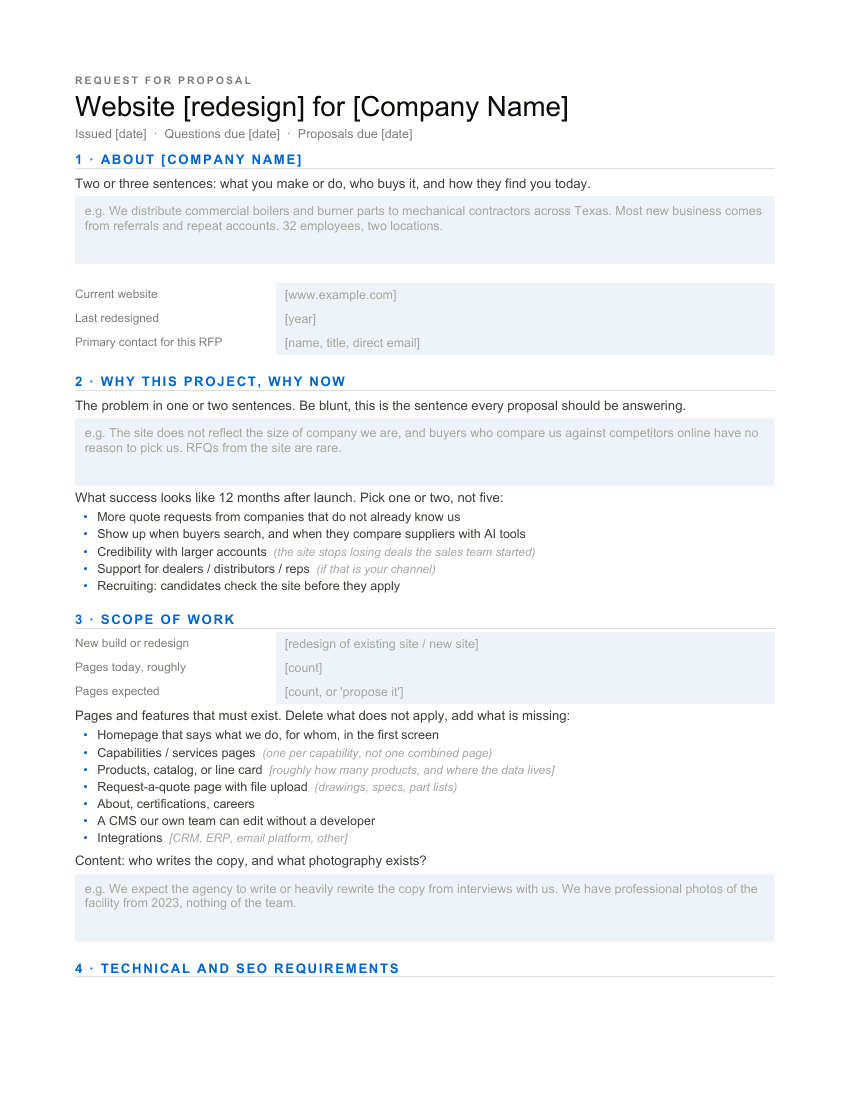
Example answers use a fictitious industrial distributor. The full document is two pages; page two covers technical and SEO requirements, budget, selection criteria, and process dates.
The Word file opens in Word, Google Docs, or Pages, and Word is the version you’ll want, since an RFP gets edited, not just filled.
If it’s a redesign, the RFP has one extra job
A new site has nothing to lose. A redesign does: every ranking, every indexed page, every backlink the current site has earned is an asset the project can silently destroy, and the buyer usually finds out two months after launch when the phone goes quiet. Your rankings belong to URLs, not to your company, so a redesign that changes URLs without a plan forfeits them.
That’s why Section 4 of the template requires four things in writing from every proposal: a full URL inventory before anything is removed, a one-to-one 301 redirect map from every old URL to its new equivalent, a baseline of rankings and Search Console data before launch, and monitoring for at least 60 days after. None of this is exotic. Every agency that has done redesigns properly will answer it in a paragraph, which is exactly the point: the ones who can’t are telling you something.
It also protects you from the quieter failure mode, content thinning. Redesigns love white space, and the copy that gets cut to create it is often what the page was ranking for. Requiring the inventory first means every cut is a decision, not an accident. The same discipline applies to the pages themselves: what a B2B website needs to say to qualify you is a content question, not a layout one.
The mistakes that ruin website RFPs
Sending it to ten agencies.Response quality tracks the odds of winning. Send it to three to five agencies you’ve already screened, tell them how many are on the list, and you’ll get proposals written by people who think they can win.
Hiding the budget.Covered above, and worth repeating because it’s the most common one: no range means no comparable proposals. Stating a range doesn’t weaken your negotiating position; withholding it costs you weeks of clarifying calls.
Describing features instead of problems.An RFP that specifies the carousel, the mega-menu, and the chatbot has already done the agency’s job, badly. State the problem and let the proposals compete on the solution. That’s the part you’re paying for.
Choosing on price alone. If the cheapest proposal wins automatically, the RFP was an auction, and agencies price auctions by cutting the invisible work, which on a redesign is usually the SEO migration. The weighted criteria in the template exist to keep price at 15%, where it belongs.
When the proposals arrive, score them against those criteria on paper: the RFP scoring matrix is the same weighting, prefilled and editable, with a worked example.
Skipping the references. Two phone calls to past clients tell you more than twenty pages of proposal. Ask what changed after launch, whether the team stayed the same, and what happened the first time something broke. If you want to see how we answer these questions ourselves, who we are and how we work is public, and we'll show rather than tell: send us your site and we'll return a complimentary homepage mockup, no call required.
Common questions
What is a website RFP?
A website RFP (request for proposal) is a document a company sends to candidate web design agencies describing the project, goals, budget range, requirements, and selection criteria. Agencies respond with structured proposals the company can compare side by side. Two to four pages is typical.
Do I need a formal RFP to hire a web design agency?
Not always. If the decision belongs to one or two people and the project is in the tens of thousands, comparing two or three agencies against a written brief works fine, and this template serves as that brief. The formal process earns its overhead when procurement rules require it, when a board needs to see a defensible decision, or when the project is large enough that a wrong choice is expensive to unwind.
Should I include a budget range in a website RFP?
Yes. Without a range, agencies guess, and the proposals that come back are scoped to different imaginary numbers, which makes them impossible to compare. A stated range gets you proposals built to reality and quietly filters out agencies that can't work within it.
How many agencies should receive a website RFP?
Three to five. Good agencies estimate their odds before investing in a response, and a mass-distributed RFP gets shallow answers or none. In our experience the quality of responses drops faster than the quantity rises.
What's the difference between an RFP and an RFQ for a website?
An RFQ prices a fixed specification; an RFP requests a proposed solution to a stated problem. Website projects are almost never fully specified up front, so an RFP (or an informal brief built like one) is the right instrument. If you're comparing the two, the RFP vs. RFQ comparison covers when each applies.
How much does a B2B website redesign cost?
Ranges vary widely with scope: page count, custom features, content, and who writes the copy. Established B2B companies hiring an experienced agency for a full redesign are typically in the tens of thousands; our own projects start at $15,000. Whatever the number, require itemized pricing so proposals can be compared line by line rather than as one opaque total.
Can you provide an RFP template for website development?
Yes. The template on this page covers both cases: a new build and a redesign. It includes the background and goals section agencies need to quote accurately, the functional requirements list, the SEO and migration requirements that protect what an existing site has already earned, the evaluation criteria, and a timeline. Download it, delete what doesn't apply, and send the same document to every firm so the proposals come back comparable.
What should a website redesign RFP include that a new-build RFP doesn't?
Four things, all about protecting what the current site has earned. A full URL inventory before anything is removed. A one-to-one 301 redirect map from every old URL to its new equivalent. A baseline of rankings and Search Console data captured before launch, so you can tell afterward whether traffic moved. And monitoring for a defined period after launch, with someone named as responsible. A new build has none of this to lose. A redesign can quietly forfeit years of search equity, and the buyer usually finds out two months later when the phone goes quiet.