The capability statement, and how to write one that wins work

A capability statement is a one to two page document that summarizes what your company does, who it serves, its core competencies, differentiators, certifications, and past performance. Industrial buyers, procurement teams, and government contracting officers use it to qualify a supplier fast, usually before any conversation.
Download the Template↓Word + PDF, no email required
What a capability statement is, and who reads it
The document exists because a buyer deciding whether to shortlist you doesn't want your full brochure. They want the answer to one question: can this company do the work, and is it safe to choose. A capability statement answers it on a single page.
It's a standard part of government contracting, where a contracting officer may glance at dozens [1]. It's just as useful in industrial procurement, where an engineer or purchasing manager is comparing a few suppliers before sending an RFQ. In both cases the reader is skimming, fast, for a reason to keep you in or take you out. The credibility signals a buyer checks are the same ones that make a statement land.
What goes on a capability statement
Eight fields, each earning its place. This is what to include, and what a buyer is looking for in each.
| Field | What to include |
|---|---|
| Header | Company name and logo, plus a one-line overview of what you do, in a sentence someone outside your industry could repeat. |
| Core competencies | 3 to 6 bullets, in the buyer's language, in priority order. An at-a-glance list that qualifies or disqualifies a job. Not a sales pitch. |
| Differentiators | 2 to 4 concrete, comparative reasons a buyer chooses you over a similar company. Use data. Keep it brief. |
| Past performance | Clients in order of relevance to this buyer, each with the period of performance and scope or dollar value. Depth lowers the buyer's sense of risk. |
| Key clients | Named clients or logos. Proof a buyer recognizes does more than a paragraph of claims. |
| Company snapshot | Founded year, locations, and geographic area served. For government work: UEI, CAGE code, NAICS and PSC codes, contract vehicles, and business classifications. |
| Certifications and licenses | ISO, AS9100, trade licenses, and any socioeconomic certifications. Logos are fine here too. |
| Contact | A named person and title (not a generic sales@ or info@), direct phone, email, address, and website. |
How to write a capability statement that gets you shortlisted
- Start from the buyer's decision, not your history.The reader isn't browsing, they're deciding whether to shortlist you. Lead with what you can do for them, not with the year you were founded. The story can wait for the site.
- Be specific and verifiable.Numbers beat adjectives. "Holds ±0.0002 inch on Swiss lathes up to 32 mm" tells a buyer more than "precision machining excellence," and it can't be said by a competitor who can't do it.
- Make the differentiators comparative.A buyer is holding two or three of these at once. State why you're the right choice over the others, not just what you are. Being the best option is always relative to the alternatives on their desk.
- Keep it to one page.The whole value is speed: a buyer should get the picture in under a minute. If it runs to three pages, it has stopped being a capability statement and become the brochure it's meant to replace.
- Tailor it to the opportunity.One base document, lightly adjusted per opportunity. Lead with the competencies and past performance closest to the work in front of the buyer, so the fit is obvious at a glance.
The capability statement template
Here it is, filled in with a worked example so you can see the difference specifics make. Download it fillable (PDF) or editable (Word), then replace each field with your own.
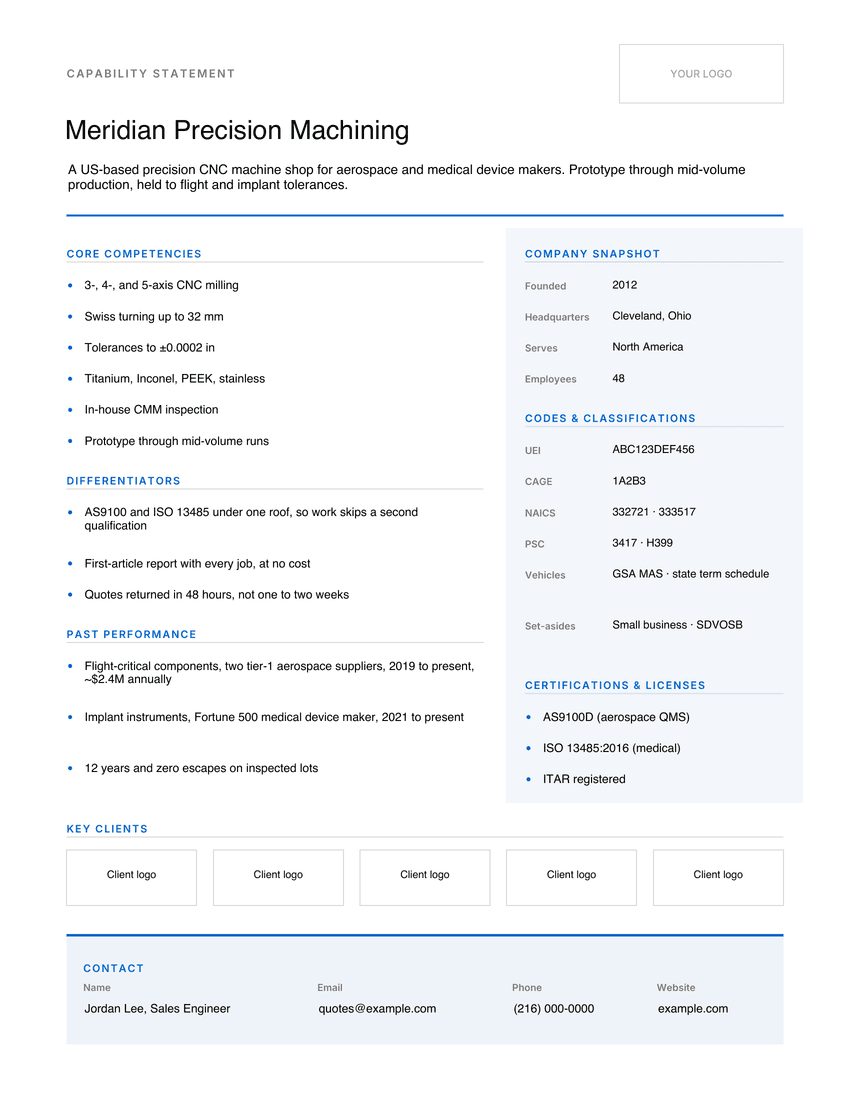
Filled in with a fictitious company (Meridian Precision Machining). Government-specific fields (UEI, CAGE, NAICS) are optional.
The PDF is fillable in any reader; the Word file opens in Word, Google Docs, or Pages.
A capability statement example
Here is the same template written out, for a fictitious precision machine shop, so you can see the level of specifics that make a buyer confident.
- Header
- Meridian Precision Machining. A US-based precision CNC machine shop for aerospace and medical device makers.
- Core competencies
- 3-, 4-, and 5-axis CNC milling and Swiss turning; tolerances to ±0.0002 in; titanium, Inconel, PEEK, stainless; in-house CMM inspection; prototype through mid-volume production.
- Differentiators
- AS9100 and ISO 13485 certified under one roof, so aerospace and medical work skip a second qualification. First-article reports with every job. Quotes in 48 hours.
- Past performance
- Flight-critical components for two tier-1 aerospace suppliers (2019 to present); implant instruments for a Fortune 500 medical device maker (2021 to present); 12 years, zero escapes on inspected lots.
- Key clients
- Two tier-1 aerospace suppliers; a Fortune 500 medical device maker.
- Company snapshot
- Founded 2012, Cleveland OH; serves North America. UEI 0123456789, CAGE 1A2B3. NAICS 332721, 333517. ITAR registered.
- Certifications
- AS9100D, ISO 13485.
- Contact
- Jordan Lee, Sales Engineer. quotes@example.com, (000) 000-0000. Cleveland, OH. example.com.
The capability statement for government contracting
In federal contracting a capability statement is close to mandatory [2]. Contracting officers and prime contractors use it to vet subcontractors, and it needs a few identifiers the commercial version doesn't, most of them pulled from your SAM.gov registration [3]. Put these in the company snapshot so an officer can confirm eligibility at a glance:
- Your UEI and CAGE code from your SAM.gov registration.
- The NAICS and PSC codes for the work you do, with short descriptions.
- Any socioeconomic classifications you hold: small business, WOSB, SDVOSB, HUBZone, 8(a).
- Contract vehiclesyou’re on: GSA schedules, BPAs, IDIQs.
Everything else, core competencies, differentiators, and past performance, stays the same, though past performance carries extra weight in government work: name the agency, the contract value, and the period of performance wherever you can. If you're new to federal work, the no-cost APEX Accelerators program helps small businesses build and sharpen a capability statement [4].
Turn the document into a website that never stops qualifying you
The capability statement has a quiet successor: your website. A buyer researching you pulls up the site before they ask for a PDF, and if your capabilities page answers the same questions the statement would, you're being qualified while you sleep. If it says "quality and service since 1987," you're not. That's the gap a capabilities-led B2B website is built to close, and it's covered in the capability statement glossary entry too.
If your site still reads like a brochure while your statement does the real selling, that's the thing to fix. We rebuild B2B and industrial sites around the questions buyers actually ask, and we'll send you a complimentary mockup of your homepage, rebuilt, with no call required.
And when you're on the other side of the table, hiring an agency rather than answering one, the website RFP template is this document's buyer-side counterpart.
Common questions
What is a capability statement?
A capability statement is a one to two page document summarizing what a company does, who it serves, its core competencies, differentiators, certifications, and past performance. Buyers and contracting officers use it to qualify a supplier quickly, often before any conversation.
What should a capability statement include?
Core competencies in the buyer's language, differentiators framed against the alternatives, past performance a buyer can verify, the certifications and codes that gate your work, a company snapshot (for government work, your UEI, CAGE code, and NAICS codes), and current contact details. Specific and checkable beats broad and flattering.
How long should a capability statement be?
One page is the norm, two at most. Its value is speed: a buyer should get the whole picture in under a minute. Anything longer stops being a capability statement and becomes a brochure.
What's the difference between a capability statement and a capabilities page?
A capability statement is a one to two page document, often a PDF, handed over during qualification. A capabilities page is the same information living on your website, where buyers now look first. The document is a snapshot; the page is always on. Most companies need both, saying the same thing.
Do I need a capability statement for government contracting?
For federal work it's close to mandatory. Contracting officers and prime contractors use it to vet subcontractors, and it needs identifiers the commercial version doesn't: your UEI and CAGE code from SAM.gov, relevant NAICS and PSC codes, and any socioeconomic classifications like WOSB, SDVOSB, or HUBZone.
Sources
- U.S. Department of Health and Human Services, “Write a Capability Statement.”
- U.S. Small Business Administration, “Basic requirements” (federal contracting).
- U.S. General Services Administration, System for Award Management (SAM.gov).
- APEX Accelerators (U.S. Department of Defense), apexaccelerators.us.