A few years ago I sat across from a client we had worked with for a while. Substantial engagements, senior buyers, the kind of B2B firm where a decision is large enough that hardly anyone chooses a partner from a search results page. They had a question for me: could we help them push harder on SEO?
They had been at it for about a year. A substantial budget burned through over the year. They had reports on their desk showing keyword rankings creeping up. The agency they had been working with told them the strategy was working, they just needed to commit more.
'We just need to win these terms,' they said. 'Once we're on page one, the inbound will follow.'
They were wrong, and most people in their seat, I think, would have been wrong with them. The buyers they wanted were not shopping for them on Google at all.
How buyers of six-figure engagements tend to find a firm
In our experience, the buyer for a high-six-figure professional-services engagement does not type a query into a search bar and pick a vendor off page one. They get a recommendation from someone whose work they already trust. They look the firm up by name. They check LinkedIn. They ask a few other executives in their network. If they search at all, the search is confirmatory, not exploratory.
That single fact changes what 'ranking well' is even worth. If your buyer is using search to confirm something they already heard, you do not need to be on page one for high-volume terms. You need to exist on page one for your firm's exact name and the specific service the referrer mentioned. Those are different problems with different solutions.
And the dashboard you are looking at every Monday morning, the one showing impressions and ranking lifts and crawl coverage, is reporting on a channel your buyer is not using.
Search is confirmatory, not exploratory, at this price point.

Why the local-services SEO playbook doesn't transfer
The SEO playbook that works for a local services business does not transfer to enterprise B2B. A plumber's customer types 'plumber near me' at the moment they need a plumber. The query is itself the buying signal. The plumber wins by appearing in the snack pack with reviews and a phone number.
A $500,000 consulting engagement does not work that way. The buyer's path starts months earlier, in a board meeting, at a peer-CEO dinner, in a LinkedIn message from a former colleague. By the time they search anything, the shortlist already exists. They are checking that you are real, that the work matches what the referrer described, and that you look like a firm their team can defend.
This is not a volume problem. It is a fit problem.
Channel fit is upstream of every metric your SEO dashboard shows.
Keywords you can win, keywords you can't, pages nobody reads
When we audit budgets in this shape, three patterns show up over and over.
1. The keywords you can win are not the keywords your buyer types.
You can probably take a category-leading position on 'managed IT services Wisconsin' if you put a year and a serious budget behind it. Your buyer, the COO of a 50-person manufacturer who needs a strategic partner, did not type that. They typed your firm's name after their advisor mentioned you, and they typed it once.
2. The keywords your buyer might type are owned by Deloitte and McKinsey.
For terms like 'digital transformation consulting,' the page-one slots are held by firms whose marketing budgets are larger than your annual revenue. You are not going to outspend them, and you are not going to outflank them on domain authority in the time horizon a real business can plan around.
3. The pages you ranked for hardly anyone reads.
We see clients who rank for a long list of terms with thin content pages built specifically to rank, and hardly any of those pages have ever converted a lead. The pages exist for an algorithm, not for a buyer. The algorithm pays them an impression. Buyers rarely pay them anything.

Why the quarterly report looks like progress
The number is going up. That is the seductive part. Rankings improve, impressions climb, the agency sends a quarterly report with green arrows. It feels like progress, and by some measures, it is progress.
The piece that does not show up on that report is which of those impressions came from anyone close to your actual buyer. There is no column that says 'C-suite executive at a 200-plus-person company who is a fit for our engagement model.' There is a column that says 'sessions.' Those are not the same number, and the gap between them is where the budget is going.
The dashboard reports on a channel your buyer is not using.
The other piece: most of the people telling you the strategy is working have a financial incentive to keep telling you that. We have sat in rooms where the CEO felt something was off and asked, and got back 'no, that makes sense, we just need more time.' Most of the people saying it were not lying. They were doing the work they were paid to do, on the assumption that what they were measuring was the right thing to measure.
Moving the budget to where the buyers are
With the client I started this piece with, we eventually told them straight: we could keep pushing the SEO budget, but we strongly recommend not doing it. Their audience was on LinkedIn. Their audience read posts from peer executives, took intro calls based on a warm introduction, and treated the firm's website as a sanity check, not a discovery channel.
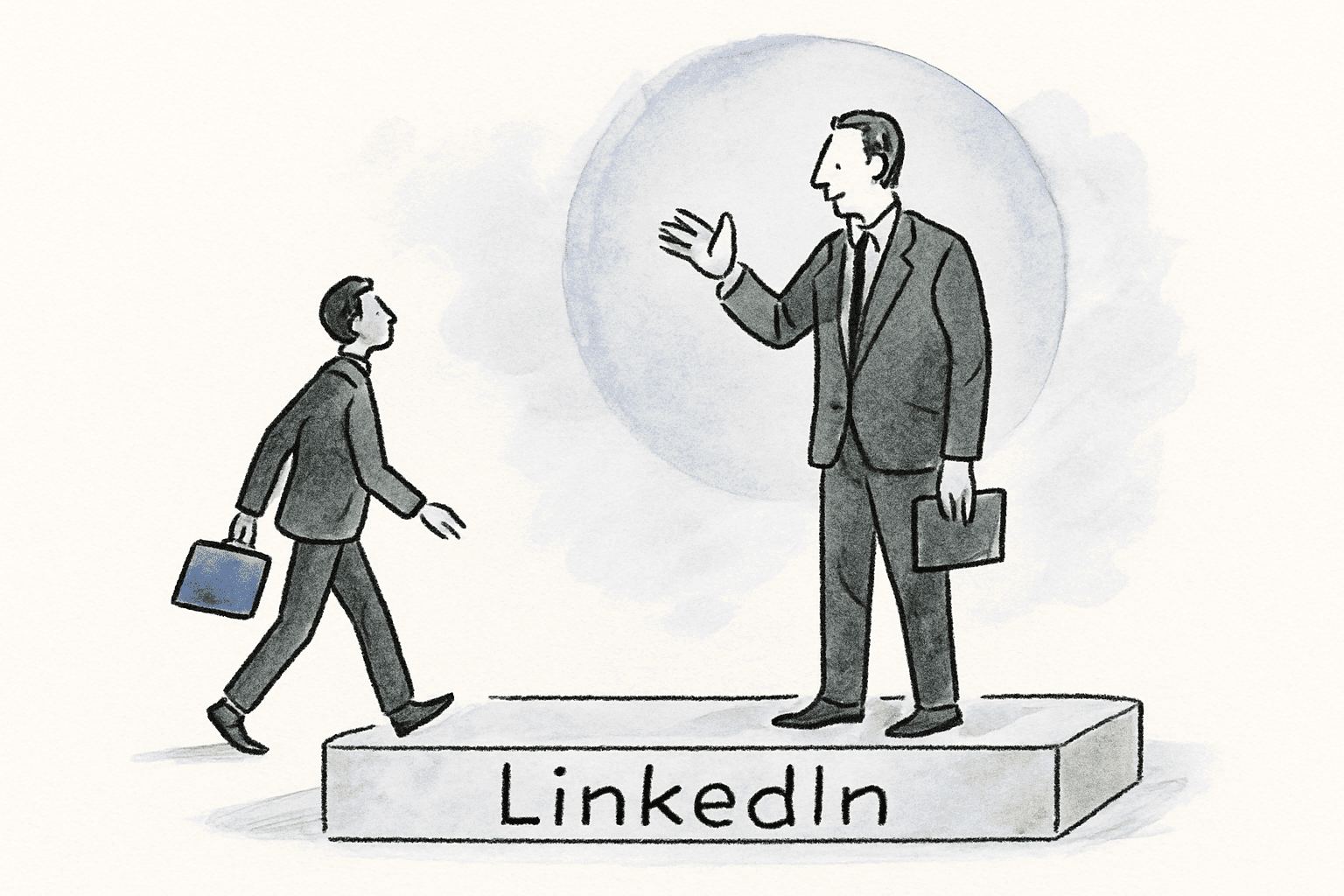
We pivoted them to LinkedIn content from the partner team plus paid promotion against a tight audience of titles at the right kind of company. The point of the content was not to go viral. It was to make sure that the next time a peer executive saw their name in a message, the LinkedIn profile already had three pieces in the feed that signaled credibility on the specific topic.
The pivot worked, in the direction that matters. The inbound that arrived was different in shape: pre-qualified, warm, and asking the right kind of follow-up questions. We were not paid for that recommendation. It came out of an existing partnership and we gave them an honest read.
The most useful thing we did that year cost them nothing extra.
Where deals start, versus what the dashboard credits
You do not need to hire anyone to start checking this. Three things, in order, this week.
- Pull your last twelve months of closed-won deals. How many came in through organic search? How many came in through a referral, a LinkedIn message, or a relationship? If the answer is heavily one column, your budget should match.
- Look at the top three search terms you currently rank for. Would the CEO who is your ideal customer ever, in a normal day, type that phrase into Google? If you cannot picture them doing it, you are not ranking for them.
- Ask your last five new clients where they first heard about you. Not where they found you. Where they first heard the name. The first-touch channel is almost never the channel that gets credit in the dashboard.
Rank for your name, then follow the buyer
This is not a case for abandoning SEO. There are categories and price points where organic search is exactly the right channel. A local services business with high search intent in its zip code should absolutely care about ranking. A high-volume B2C product can build a real business on SEO.
For an established B2B service firm selling six-figure engagements to senior buyers, SEO is usually somewhere between a niche channel and a sanity-check layer. You want to rank for your firm's exact name. You want a clean, fast site that loads when the referrer's contact pulls it up on their phone. You probably do not want to spend a substantial annual budget trying to outrank McKinsey for a generic term.
What you do want, in our experience, is a channel and content strategy that matches where the actual decision happens. For most of the firms we work with, that means a marketing site that earns trust quickly, a referrer-friendly path through it, and a content footprint on the channel your buyers actually use.
If you are not sure which bucket your business falls into, that is exactly the question a second opinion answers. We will tell you straight whether organic is your right channel and, if it is not, what we would do instead. Sometimes the answer is 'keep doing what you are doing.' Sometimes it is 'stop spending money in this direction tomorrow.' Get a complimentary breakdown and we will tell you which.
Channel fit beats channel rank, every time.