I was on a call last year with the owner of an established service business. Real reputation in their industry, a team of about fifty, a referral pipeline that had stayed steady for a decade. By every reasonable measure, the owner was good at their job.
We were doing a quick walkthrough of their site. I asked them to do something simple: scroll the homepage and tell me, out loud, what someone who'd never heard of their company would think the company did.
The owner read the headline. Paused. Read the supporting paragraph. Paused again. Then said, "Honestly, I'm not sure they'd know."
They were reading their own site for the first time in years. They couldn't. Not because the site was hidden. Because they had been describing their company verbally for so long that they were unable to read what was actually on the page. They kept reading what they expected to be there.
Why familiarity blocks the owner's read
In our experience, this is the most common blind spot in any established-business audit, and it has nothing to do with intelligence or attention. It's a function of how the brain handles repeated input.
When you describe your business to a prospect, you are working from the current version that lives in your head. When you look at your website, your brain treats the page as a confirmation of that description, not a fresh read. You see the headline you wrote three years ago and you supply the missing pieces from your own current understanding. A first-time visitor has no such reservoir. They see only what is there.
The site has not changed. Your mental model of the site has not changed. But the business has. The gap between the site and the business has been growing the whole time, and you, the owner, are the worst person in the company to detect it. One version of this is worth checking on its own: whether the site is still written for the customer you had before the business changed.
You supply the missing pieces from your own current understanding.

Why 'fresh eyes' usually aren't fresh
The standard advice is to ask someone outside the company. That works, sometimes. But "fresh eyes" is usually a friend, a peer, or a board member, all of whom have one thing in common: they already know what your company does. They are not true outsiders. They are people who give you the answer you already have because they share your context.
A real outsider is someone with no relationship to you, no industry context, and no obligation to be polite. Their reactions are the ones that matter for the website, because they are the ones the website was actually built for.
The substitute for a real outsider is not asking a friendly insider. It's a small set of exercises that simulate a first-time visitor's read without one in the room. None of them are perfect. All of them are better than reading the site yourself.
Four ways a self-audit misses what visitors see
- The owner reads what they remember writing. Most established-business owners wrote, or signed off on, the homepage copy years ago. They reread it now and recognize their own voice, which feels correct. Recognition is not the same as reading.
- The owner skips the parts a visitor lingers on. The owner scrolls past the hero section because they've seen it a thousand times. The visitor stops there, because that is where they decide whether to keep going. Most owners spend their attention on the wrong sections of their own site.
- The owner reads the right pages in the wrong order. Owners tend to click straight to About or Work, because those are the pages they think of when they think of the site. Visitors usually never make it that deep. The pages that matter for conversion are the first one and the contact path, and those are the pages the owner pays the least attention to.
- The owner reads with sound off, on a wide monitor, logged in. Visitors read on phones, in line, distracted. The site looks different in those conditions. Most owners have not seen their own site through that lens since launch day.
Nothing prompts anyone to look again
The sites in this state weren't built badly. They were built well enough that the owner stopped looking. There is no internal trigger that says "review the website this quarter." There is no business meeting where the website is the agenda. The site stays good enough for years, gradually drifts from the business, and the owner is the last to know because their mental model of the site is the version that worked, not the version that's live.
The marketing person on the team often does notice. They are usually the ones quietly editing what they can and giving up on what they can't. But by the time the issue reaches the owner, it has been filed under "we should probably look at the website at some point," which is where it stays.
The list mattered less than the quarterly review that followed
A client of ours sat down with their own site after we walked them through a structured read, and within ten minutes had a list of changes they wanted to make. None of them were design changes. All of them were about what the site said.
The biggest shift was not the list. It was that they realized they had been blind to it for two years. Once that happened, they stopped trusting their own read of the site and started building a process for outside review. Quarterly. Cheap. Built into the calendar.
The site itself got materially better in the next month. The bigger long-term result is that they will not drift back to the same place, because the process for catching the drift is now in place.
Recognition is not the same as reading.
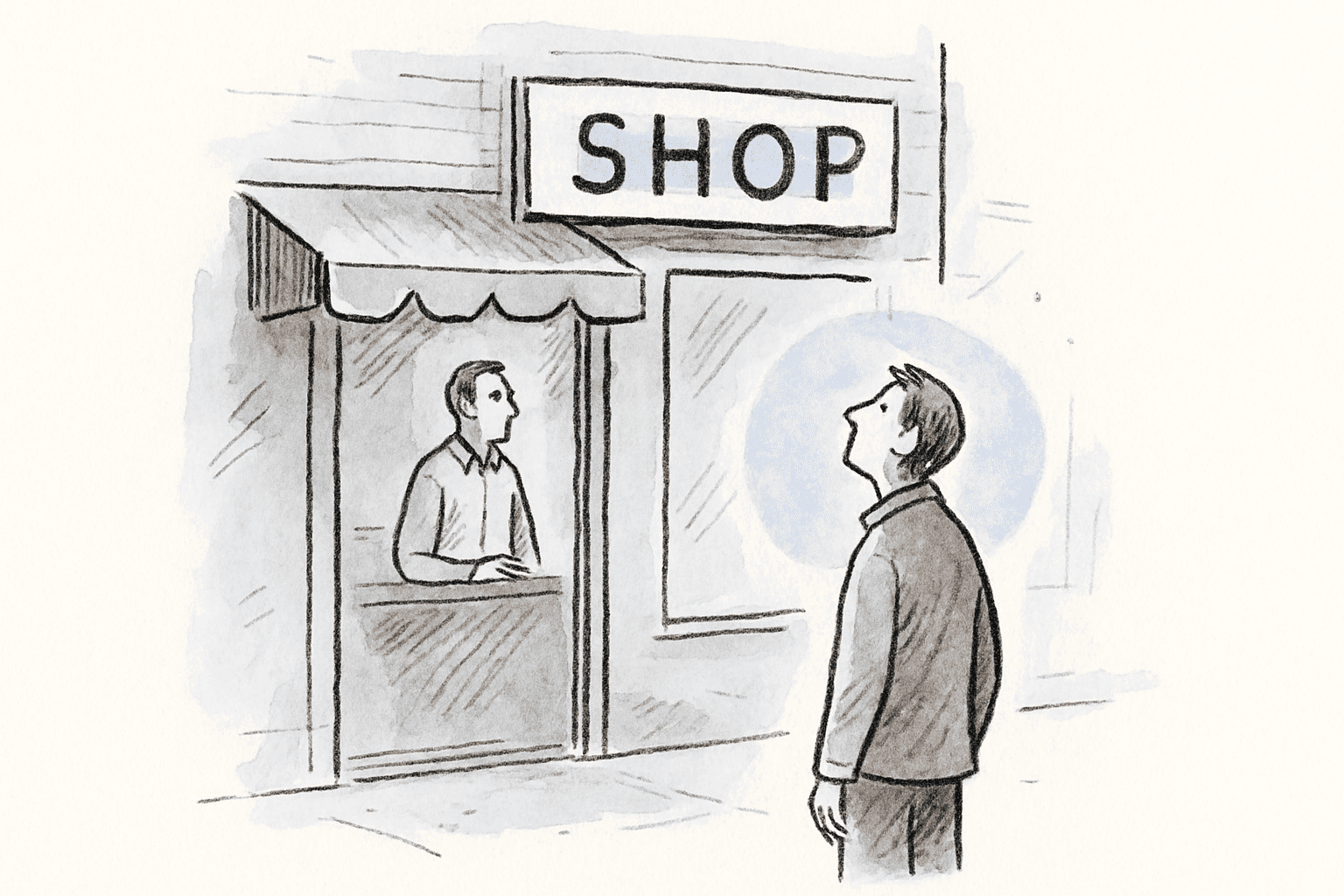
Simulating a first-time visitor's read
- Open the site on your phone, in your car, with mobile data, while sitting in a parking lot. Read the homepage and the services page. Note every time you have to wait, scroll past a broken element, or pinch to zoom. That's what a real visitor experiences.
- Ask three people who do not work in your industry to look at your homepage for thirty seconds and then tell you, in their own words, what your company does and who it's for. If you get three different answers, the homepage isn't doing its job.
- Print the services page and read it aloud at a normal speaking pace. Anywhere you stumble, anywhere you find yourself adding context that is not actually on the page, mark it. That gap is what a potential customer experiences.
Write down what the tests find
The cheapest version of fixing this is the three tests above, run honestly, with the results written down. That alone surfaces most of the structural problems on most established-business sites. In our experience one of the most common is a homepage that doesn't say what you do.
The next step up is an outside audit by someone who does this for a living. We audit for the patterns that are invisible from the inside. We will tell you whether what's wrong is fixable in an afternoon or whether it warrants something bigger like a marketing site relaunch. We work with established service businesses, and most of what we find is not what owners expect.
If you'd like that outside read on your own site, we'll put together a complimentary breakdown. It's yours to keep either way.