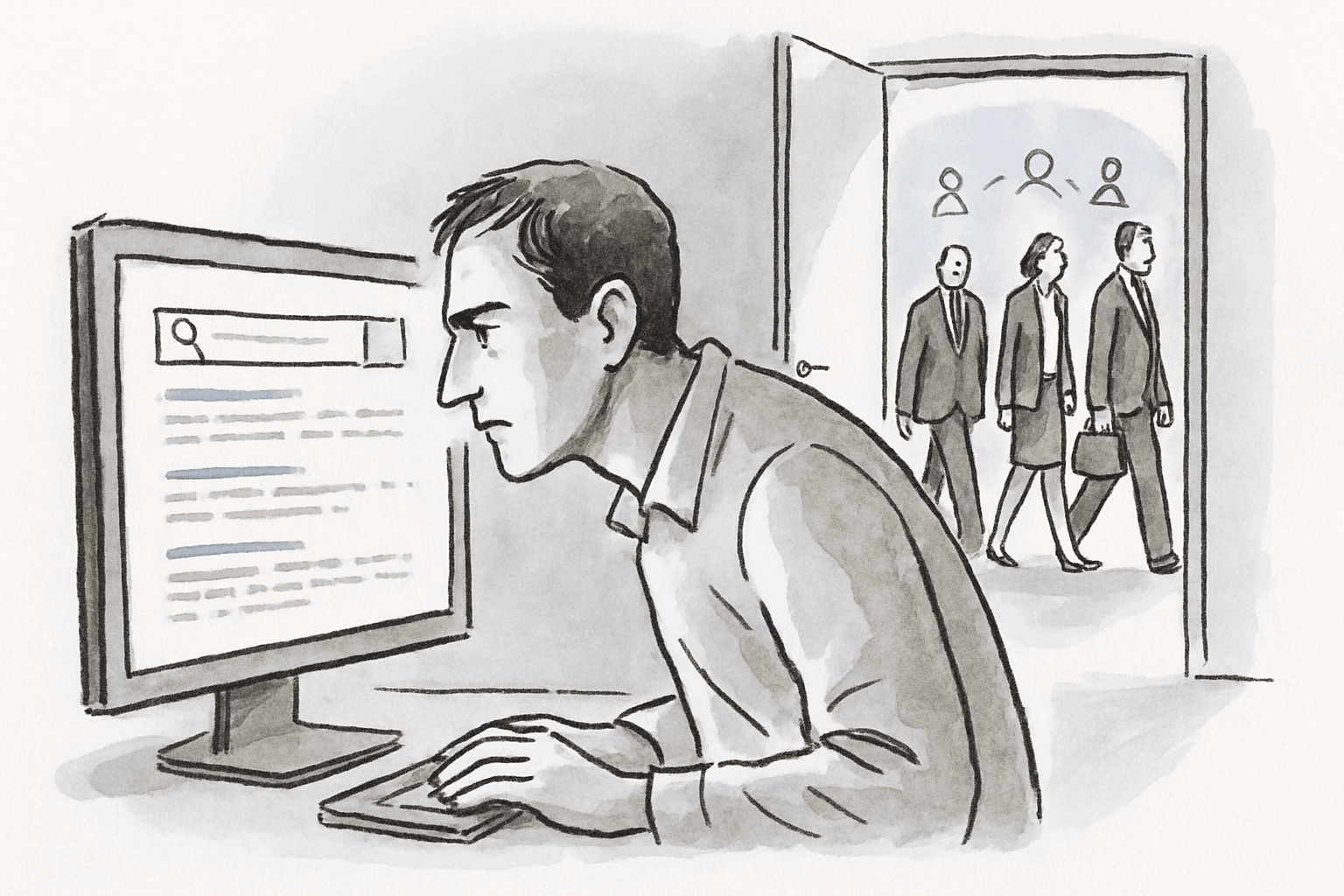
I asked a CEO we work with last year who maintained the website. He did not pause. 'Marketing has it.' We pulled the site up on the screen, and I asked him to walk me through the services page.
He scrolled, frowned, and pointed at a section that did not exist. 'We do a lot of that work now. That is a big piece of revenue. We have been meaning to add it.'
'How long have you been meaning to?' I asked. He thought about it. 'Maybe two years?'
His marketing team had been trying to update that section the whole time. They did not have the tools.
The actual reality
In our experience, when a small website change has lived on a to-do list for more than a quarter, the problem is almost never effort or care. The marketing person assigned to the site has tried. They have written the copy. They have asked the developer who built it. They have waited, and then waited again, and eventually moved on to something they could actually finish.
The site they inherited was built well, often beautifully, by a team that left when the build was done. Nobody mapped the path from 'we want to change this paragraph' to 'the change is live.' There is no CMS, or there is one nobody trained anyone on. The design system, if it exists, lives in someone's head. A new section needs new components, new layout decisions, and a developer to ship it. The marketing person does not have any of those things.
The work the marketing team is being asked to do is closer to engineering than to marketing. They are not engineers. That is not a flaw in your hiring.
Tooling is the gap. Not effort.
Why this is different from what they think it is
There is a story owners tell themselves that goes: 'I have a marketing person. Marketing owns the website. So the website is being maintained.' Each step in that chain sounds reasonable. The chain breaks at the second step, but quietly, because nobody is going to walk into your office and announce 'I cannot do the thing you assigned me, and I have not been able to for a year.'
Most marketing hires are excellent at marketing: campaigns, copy, positioning, channel mix, brand voice. None of those skills are the same as 'can deploy a new section of a custom-built website by Friday.'
Treating the website as a marketing problem when it is a platform problem keeps you stuck.
When the platform is wrong, the people are not the fix.
The most common reasons it fails
1. The site has no CMS, or one that does not match the real changes.
Plenty of beautifully designed sites are built without an editor at all. Every change is a code change. Even sites that do have a CMS often only let you edit text in pre-defined slots. The change your business actually needs (a new service offering, a different homepage structure) does not fit any of those slots, so it goes back to the developer queue.
2. There is no design system, so every change is a one-off.
If the site does not have a consistent component library, adding a new section means redesigning that section from scratch. That is a half-day of design plus a developer plus a round of review. For a marketing person operating between five other initiatives, that is not happening on any given Friday.
3. The 'ask the developer' loop has a turnaround long enough to die in the queue.
Small change submitted. Two weeks of waiting. The brief is now stale because something else moved. The change gets revised. The developer is on a different project. Three months pass. The marketing person gives up and writes about it on LinkedIn instead.
Why they cannot see it themselves
The owner sees a marketing org chart and an outdated services page and connects them in a straight line. The marketing person sees a wall they cannot get through and a list of other things they can actually finish, and finishes the other things. Neither of them is wrong about what they see.
The pattern is invisible to the owner because nobody escalates a slow tooling problem. They escalate budget. They escalate hires. They escalate revenue at risk. Nobody walks into the conversation saying 'the actual blocker is that the website has no editor and the developer who built it left in 2019.' That phrasing does not sound like a problem the owner is supposed to solve. It sounds like an excuse.
Nobody escalates a slow tooling problem.
What changes when you fix it
With the client I started this piece with, we did not start by hiring more marketers. We audited the editing layer first, and then gave the marketing team a site they could actually edit. Headers, hero copy, services, case-study summaries, FAQ, a new section when the business adds one: all editable through a real CMS, mapped to a design system that produces a finished page every time.

Within a couple of weeks of going live, the services page reflected what the business actually did. The section that had been 'on the list' for two years shipped within days. Not because the marketer suddenly tried harder, but because the request stopped being 'go negotiate with the developer queue' and started being 'open the editor, type, hit publish.'
The downstream effect was bigger than the page. A team that had spent two years being told they 'owned' the website without being able to change it had assumed the website was just slow. Once they could ship, they shipped weekly. Small updates that had piled up came out in a month. The site started looking like the company actually behind it.
Building once well is cheaper than maintaining badly forever.
Tests you can run yourself
Three checks you can run this afternoon, without commissioning anything.
- Pick the smallest currently-broken thing on your site. A paragraph with an outdated number, a service that no longer matches, a stale team member. Time how long it takes to go live. Hours is healthy. Weeks is the symptom. Months is the diagnosis.
- Ask the person who owns the website to walk you through making one change end to end. Watch where the hesitations are. The point at which they say 'I would have to ask the developer for that' is the wall.
- Pull the last six months of website to-do items. How many got shipped? How many got punted? The shipped-to-punted ratio tells you whether you have a tooling problem or an attention problem, and they look very different.
What I would actually recommend
The fix is rarely a bigger marketing team. It is a marketing site built so the people you already have can actually maintain it. That usually means a real CMS scoped to the changes the business actually makes, a design system that produces consistent finished pages, and a documented handoff so the next person in the seat knows where the levers are.
You do not need to throw the existing site out to get there. We have done partial migrations where the front-end stayed and only the editing layer changed. We have done full relaunches where the business had outgrown the structure entirely. The right answer depends on how badly the current platform is in the way, and the team you work with should be honest with you about that.
If you have not looked at this lens in the last three years, it is probably overdue. A free audit is the cheapest way to find out which bucket you are in. We will tell you straight whether the fix is a small tooling change, a deeper rebuild, or honestly nothing at all. Either way, you will know.
Ownership without authorship is a trap.